


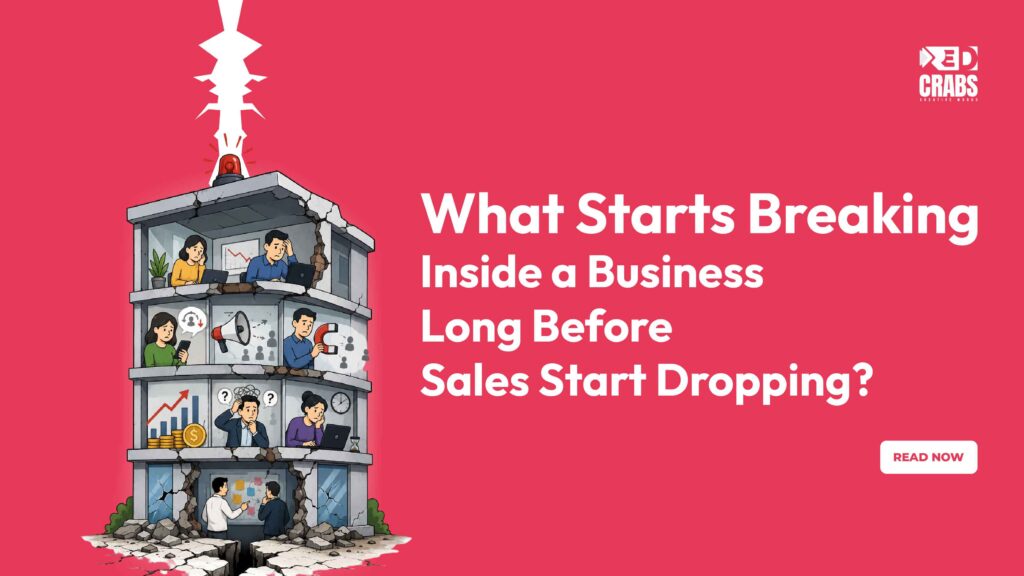
Most businesses don’t lose customers overnight.
They don’t wake up one morning to discover that revenue has suddenly disappeared, loyalty has vanished, and competitors have taken over. Declining sales are usually treated as the moment a problem becomes visible, but in reality, they are often the final stage of a much longer process.
Long before revenue begins to fall, something else starts changing.
Customers become slightly less engaged.
Brand interactions become more transactional.
Trust becomes a little more fragile.
Recommendations become less frequent.
Competitors become more appealing.
These shifts rarely trigger immediate concern because they don’t appear as dramatically as a decline in sales. In fact, a business can continue performing reasonably well while the foundations that support future growth are slowly weakening.
This is what makes the problem so dangerous.
By the time declining sales show up on a dashboard, the real issue has often been developing beneath the surface for months, sometimes even years.
At RedCrabs, we’ve worked with brands across different industries, and one pattern appears repeatedly. Businesses often believe they have a sales problem when they actually have a relationship problem. The challenge isn’t generating transactions. The challenge is maintaining the emotional, psychological, and experiential factors that make customers want to stay.
Understanding those factors is what separates brands that grow consistently from brands that spend their entire existence trying to recover lost momentum.
The First Thing That Breaks Is Emotional Relevance
One of the earliest signs of brand decline is something many businesses never actively measure: emotional relevance.
Customers don’t simply buy products and services. They buy confidence, familiarity, trust, identity, aspiration, convenience, and reassurance. The strongest brands become part of how customers think about themselves and the choices they make.
Over time, however, that connection can weaken.
A brand that once felt meaningful begins to feel ordinary. Content that once felt relevant becomes easy to ignore. Experiences that once felt memorable start feeling predictable.
The danger is that customers don’t immediately stop buying.
They simply stop caring as much.
And when customers stop caring, they become significantly more open to alternatives.
This is where a strong Emotional Branding Strategy becomes critical. Emotional branding is not about creating sentimental advertising campaigns or chasing viral moments. It is about ensuring that customers continue to see value in the relationship they have with the brand.
Research from Harvard Business Review suggests that emotionally connected customers are significantly more valuable than highly satisfied customers because emotional connection influences long-term loyalty, advocacy, and repeat purchasing behaviour.
That insight highlights an important distinction.
Satisfaction helps customers stay.
Emotional connection gives them a reason to care.
Early Signs Your Brand Is Losing Emotional Relevance
- Customers engage less frequently with your content.
- Brand conversations become less organic.
- Recommendations start slowing down.
- Customers become more willing to compare alternatives.
- Price begins to matter more than brand preference.
None of these indicators immediately affect revenue, but collectively they signal that the relationship between the customer and the brand is becoming weaker.
Why Brand Loyalty Is More Psychological Than Behavioural
Many businesses define loyalty by repeat purchases.
While repeat purchases are certainly important, they don’t always tell the full story.
A customer may continue purchasing because switching feels inconvenient. They may continue because there are limited alternatives available. They may continue because the product is part of a routine.
Those behaviours create retention, but they don’t necessarily create loyalty.
True loyalty exists when customers actively choose a brand despite having other options available.
This is where understanding Brand Loyalty Psychology becomes essential.
Loyal customers behave differently because their relationship with the brand extends beyond the transaction itself. They trust the brand more. They recommend it more often. They are more forgiving when mistakes occur. They are less likely to leave because of a temporary pricing difference.
The psychology behind loyalty is rooted in emotional investment. When customers feel connected to a brand, they stop evaluating every decision purely through logic.
Instead, they begin making decisions through preference.
And preference is one of the most powerful competitive advantages any business can build.
A repeat customer is not always a loyal customer.
A loyal customer is someone who chooses your brand even when alternatives are available.
That distinction may seem subtle, but it changes how businesses approach growth.
The Hidden Cost of Losing Emotional Connection With Brands
Many companies focus heavily on product innovation, operational efficiency, and acquisition strategies. While these areas are undoubtedly important, they often overlook a factor that has an enormous impact on long-term growth: emotional connection.
Consumers rarely remember every feature a product offers.
They remember how a brand made them feel.
They remember whether interactions felt effortless or frustrating.
They remember whether a company delivered confidence or uncertainty.
They remember whether an experience felt human or transactional.
This is why emotional connection with brands has become such an important business asset.
Unlike products, emotional relationships are difficult for competitors to replicate.
A competitor can match pricing.
They can copy features.
They can launch similar services.
What is much harder to duplicate is the trust and familiarity customers have developed over time.
Research from PwC highlights that customer experience increasingly influences purchasing decisions, with consumers placing substantial importance on how interactions make them feel throughout the customer journey (Source).
This reinforces a simple but important reality: customer experience is no longer just an operational concern. It has become a branding concern.
What Emotionally Connected Customers Typically Do
- Stay with brands longer.
- Recommend brands more frequently.
- Engage more consistently.
- Forgive occasional mistakes.
- Generate higher lifetime value.
The value of emotional connection compounds over time, which is why businesses that invest in it often experience stronger long-term growth.
Trust Erodes Long Before Revenue Does
Trust is one of the most valuable assets any business can possess.
Yet it is rarely measured with the same level of attention given to sales, traffic, or lead generation.
The challenge with trust is that it usually doesn’t disappear dramatically.
Instead, it fades gradually.
A delayed response here.
An inconsistent experience there.
A promise that isn’t fully delivered.
A shift in quality.
A communication breakdown.
Each individual issue may seem insignificant, but collectively they influence how customers perceive reliability.
Research from Edelman consistently shows that trust remains one of the strongest drivers of consumer choice, loyalty, and advocacy (Source).
What makes trust particularly important is that customers rarely announce when it begins weakening.
They simply become more cautious.
They become less emotionally invested.
They become more willing to consider competitors.
Eventually, those behavioural changes influence purchasing decisions.
By then, the erosion of trust has already done its work.
Customer Loyalty Marketing Is About Relationships, Not Rewards
One of the biggest misconceptions surrounding customer loyalty marketing is the belief that loyalty can be purchased.
Many businesses attempt to strengthen retention through rewards programmes, discounts, cashback offers, exclusive perks, and promotional incentives.
While these tactics can influence behaviour, they rarely create genuine loyalty.
In many cases, they simply create dependency.
Customers return because they receive benefits, not because they feel connected to the brand.
The problem with this approach becomes obvious when a competitor offers a better incentive.
Relationship-driven loyalty works differently.
Customers stay because they trust the brand.
They believe in what it represents.
They consistently receive positive experiences.
They feel understood.
Many Brands Focus On
- Discounts
- Reward points
- Cashback programmes
- Promotional incentives
Strong Brands Focus On
- Trust
- Consistency
- Relevance
- Experience
- Emotional value
The second approach creates loyalty that is significantly harder for competitors to disrupt.
What Healthy Brands Measure Before Sales Drop
One of the reasons businesses miss early warning signs is because they focus exclusively on lagging indicators.
Revenue tells you what happened.
It doesn’t always tell you what is about to happen.
Brands that maintain long-term growth pay attention to signals that reveal the health of customer relationships before financial results begin changing.
Metrics Worth Monitoring
Customer Sentiment
How do customers feel about the brand?
Brand Advocacy
Are customers actively recommending the business?
Repeat Engagement
Do customers continue interacting with content and experiences?
Referral Behaviour
Are existing customers introducing new customers?
Trust Indicators
Is confidence in the brand growing or declining?
These indicators often provide a much earlier view of future business performance than sales data alone.
Research from McKinsey has found that companies creating stronger customer relationships through personalization and customer-centric experiences often outperform competitors in customer retention and long-term growth (Source).
The strongest brands understand that retention is not a by-product of growth.
It is one of its primary drivers.
The Real Question Businesses Should Be Asking
Most businesses spend considerable time asking how to increase sales.
Far fewer spend time asking why customers stay.
That difference matters.
Because long before revenue begins to decline, businesses often experience quieter warning signs. Emotional relevance starts fading. Trust becomes more fragile. Loyalty becomes conditional rather than genuine. Customer relationships become weaker.
These changes rarely appear immediately on a dashboard, but they influence every future purchasing decision.
At RedCrabs, we’ve found that the strongest brands are not always the loudest brands. They are the brands that consistently reinforce trust, relevance, and emotional connection at every stage of the customer journey. They understand the principles behind Brand Loyalty Psychology, invest in meaningful customer loyalty marketing, build stronger Emotional Branding Strategy, and continuously nurture the emotional connection with brands that drives long-term growth.
Because when customers feel connected, they stay longer.
When they stay longer, they trust more.
When they trust more, they recommend more.
And when they recommend more, growth becomes significantly more sustainable.
If you’re only looking at sales numbers to understand the health of your business, you may be looking at the final symptom rather than the root cause. The businesses that thrive for years are the ones paying attention to what is happening beneath the surface long before revenue ever starts to decline.
If you’re looking to build stronger customer relationships, deeper emotional connections, and long-term brand loyalty, explore how RedCrabs helps businesses create brands that customers remember, trust, and choose again and again.