

Marketing has not failed.
It has adapted.
For decades, traditional advertising operated on a simple formula. Buy media space. Control the message. Repeat the message. Build recall. Convert recall into revenue.
That model worked in a world where attention was scarce and media channels were limited.
But the digital era dismantled that structure.
Today, media is unlimited. Content is constant. Attention is fragmented. Consumers are informed, skeptical, and empowered.
The question is no longer how loudly a brand can speak.
The question is how credibly it is discussed.
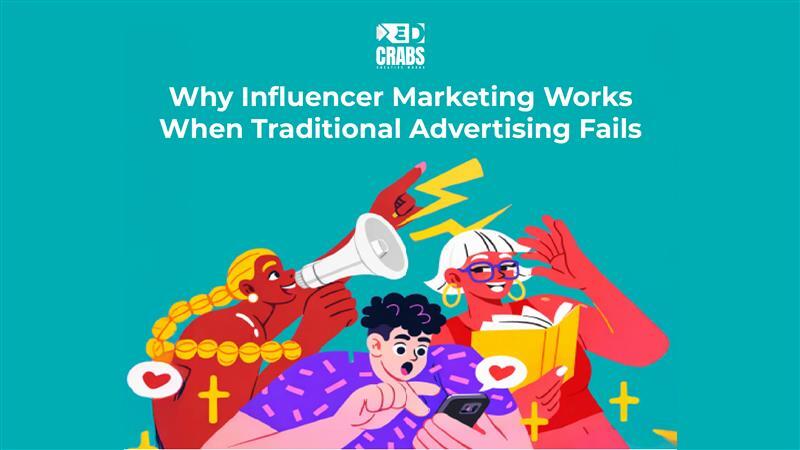
That shift explains why influencer marketing consistently delivers stronger engagement and trust than interruption-based traditional advertising.
The End of Passive Audiences
Traditional advertising thrived in passive environments.
Consumers watched what was broadcast. They read what was printed. They absorbed messages placed in front of them.
Today’s consumer is not passive.
They scroll intentionally.
They skip instantly.
They compare obsessively.
They validate socially.
Before making a decision, consumers examine:
- Reviews
- Comment sections
- Comparison videos
- Community discussions
- Creator experiences
Advertising no longer has the final word.
Communities do.
Influencer marketing operates within this validation ecosystem. Traditional advertising attempts to dominate it.
That is the fundamental difference.
The Trust Multiplier
We now operate inside what can only be described as a trust-driven marketplace.
According to (Nielsen), recommendations from individuals rank among the most trusted forms of advertising globally.
Trust is not a branding metric anymore.
It is a conversion accelerator.
Without trust, impressions remain impressions.
With trust, impressions convert.
Influencers build trust through:
- Consistency over time
- Transparency in communication
- Personal storytelling
- Demonstration instead of promises
- Direct audience interaction
When a creator integrates a product into their content ecosystem, the audience evaluates it through an existing credibility filter.
The brand does not begin from skepticism.
It enters through familiarity.
Traditional advertising attempts to manufacture trust.
Influencer marketing transfers it.
The Indian Acceleration
India offers one of the most compelling examples of influencer-driven growth.
In the early scaling stages of many digital-first brands, television was not the primary driver. Creator ecosystems were.
Mamaearth is one of the most widely observed examples. Instead of relying heavily on early-stage television dominance, the brand invested aggressively in influencer partnerships across YouTube and Instagram.
Products consistently appeared in:
- Routine content
- Parenting discussions
- Honest reviews
- Educational explanations
- Lifestyle integration formats
The brand became visible inside trusted environments repeatedly.
That familiarity built comfort.
After this model proved successful, brands across multiple industries adopted similar strategies including fintech platforms, edtech startups, consumer tech companies, fitness programs, fashion labels, and sustainable lifestyle brands.
Influencer marketing became part of the go-to-market infrastructure.
Not because it was fashionable.
Because it aligned with Indian digital behavior.
India’s online audience is participatory. It comments, debates, shares, validates, and cross-checks publicly.
Influencer marketing thrives in participatory cultures.
Demonstration Reduces Uncertainty
Across industries, uncertainty is the largest barrier to purchase.
For a fintech app, uncertainty is about security.
For a SaaS platform, it is about usability.
For a fitness program, it is about results.
For a fashion brand, it is about fit and versatility.
For consumer electronics, it is about performance reliability.
Traditional advertising declares value.
Influencer marketing demonstrates it.
Industry data from (Hub) consistently highlights strong ROI outcomes for influencer campaigns across sectors.
When creators show real usage, real results, and real limitations, uncertainty decreases.
And when uncertainty decreases, purchase confidence increases.
Relevance Over Reach
Traditional advertising optimizes for reach.
Influencer marketing optimizes for alignment.
Instead of broadcasting to a broad demographic, brands can target:
- Regional language communities
- Tier 2 and Tier 3 markets
- Startup founders
- College students
- Industry professionals
- Health-focused buyers
- Sustainability advocates
- Premium urban audiences
Insights from (HubSpot) show marketers increasing influencer investments due to measurable engagement and performance impact.
Relevance improves efficiency.
Efficiency improves profitability.
Distributed Social Proof
Traditional advertising centralizes authority.
Influencer marketing distributes validation.
When multiple creators across niches discuss a product, layered social proof forms.
This signals:
- Market legitimacy
- Community approval
- Practical usability
- Cross-segment appeal
Distributed validation feels organic.
Centralized messaging feels constructed.
Consumers instinctively trust distributed validation more.
Cultural Integration and Mental Availability
Global brands demonstrate how influencer marketing creates cultural embedding.
SKIMS integrated products across diverse creator ecosystems, normalizing visibility across communities rather than relying solely on advertising bursts.
Rhode focused on routine-based integration and creator demonstrations instead of aggressive promotion.
Rare Beauty strengthened emotional positioning through storytelling aligned with creator identity.
The principle extends beyond consumer categories.
When a brand becomes part of daily digital conversations, it builds mental availability.
Mental availability influences purchase decisions long after campaign cycles end.
Engagement as a Leading Indicator
Traditional advertising reports:
- Reach
- Frequency
- GRPs
Influencer marketing measures:
- Comments
- Saves
- Shares
- Watch time
- Click behavior
- Conversion contribution
Engagement is a behavioral signal.
Behavior predicts intent.
Intent correlates strongly with purchasing probability.
This enables performance optimization instead of assumption-driven spending.
Execution as Infrastructure
Influencer marketing only works when treated as structured infrastructure rather than sporadic activity.
It requires:
- Audience segmentation
- Strategic creator mapping
- Platform-specific content planning
- Defined KPIs
- Legal and compliance clarity
- Continuous performance optimization
We have worked with brands including Alphagoodness, DermDoc, NYBAE, Faces Canada, Good Vibes, Chicnutrix, Beco, Chemist at Play, Bare Anatomy, Sunscoop, and Juicy Chemistry.
These collaborations reflect cross-industry execution where influencer marketing campaigns were aligned with measurable objectives rather than vanity metrics.
The focus remains on clarity, alignment, and impact.
Influence without structure produces noise.
Influence with discipline produces growth.
Traditional Advertising Still Has a Role
Mass media still supports:
- National awareness
- Large-scale launches
- Broad positioning
However, in a validation-first digital economy, influencer marketing aligns more closely with how real decisions are made.
Consumers want:
- Proof
- Relatability
- Transparency
- Peer validation
Traditional advertising builds awareness.
Influencer marketing builds belief.
Belief reduces hesitation.
Reduced hesitation increases revenue.
Build Influence That Converts
Influencer marketing is no longer experimental.
It is strategic infrastructure.
It combines credibility, community alignment, and measurable performance.
Brands that understand this shift are not asking whether influencer marketing works.
They are asking how to execute it properly.
That requires:
- Deep audience understanding
- Strategic creator selection
- Platform-specific execution
- Clear performance measurement
- Continuous optimization
If you are ready to build performance-driven, data-backed influencer marketing campaigns that combine credibility with measurable business impact, consider working with RedCrabs and turn strategic influencer marketing into long-term growth.